.png)
How K9 Patrols Deter Theft and Robbery: The Security Power of Trained Dogs
Updated: Aug 29
A would-be thief may ignore a camera, wait out a guard’s walking route, or test a weak access point. A trained dog changes the calculation in seconds. The sound, movement, and presence of a K9 patrol make risk feel immediate, unpredictable, and personal.
That is why K9 teams remain one of the most visible and effective security measures for sites that face theft, robbery, trespass, and antisocial behaviour. They do not replace CCTV, alarms, lighting, or human guards. They strengthen them. A well-trained dog and handler can cover ground quickly, detect hidden people, respond to suspicious movement, and discourage offenders before a crime begins.

Why visible K9 patrols deter theft and robbery
The strongest deterrent is often not force. It is certainty of detection.
Most theft and robbery offences involve some form of opportunity. Offenders look for places where they can move unseen, leave quickly, or intimidate staff and customers without immediate challenge. A K9 team disrupts that plan.
A trained dog affects security in several ways at once:
It increases visible guardianship.
It extends the handler’s awareness through scent, sound, and movement.
It makes escape routes feel less certain.
It creates a strong emotional response in people considering violence or confrontation.
It helps security staff challenge behaviour from a safer distance.
This matters because offenders often make quick risk assessments. A poorly lit loading bay with no patrol looks attractive. The same area with a dog team moving through it at random intervals feels far less appealing.
Research into patrol deterrence supports this wider idea. The well-known Philadelphia Foot Patrol Experiment found that targeted foot patrol in high-crime areas reduced violent crime by 23% compared with similar areas without the same patrol presence. That study was not about dogs alone, but it shows a key principle behind K9 work: visible, focused patrols in the right places can reduce crime.
K9 patrols build on that principle by adding speed, sensory reach, and a clear physical deterrent.
How trained dogs enhance security measures
A K9 patrol is not simply a guard walking a dog. Effective teams rely on training, control, planning, and clear operating procedures.
Dogs expand the patrol’s senses
A human guard can see and hear only so much, especially across large spaces such as warehouses, construction sites, retail parks, distribution yards, farms, transport hubs, and car parks. Dogs add another layer of detection.
A trained patrol dog may pick up:
Movement behind fencing or storage containers
A person hiding in a dark corner or outbuilding
Fresh scent trails near entry points
Unusual behaviour in crowds
Tension or hesitation in someone approaching staff
Dogs are not magic sensors, and they should never be treated as a substitute for proper risk assessment. Yet their senses can help handlers notice threats earlier. That extra warning can be the difference between a safe intervention and a rushed confrontation.
K9 teams make patrols less predictable
Static guards and fixed cameras have clear limits. Offenders can watch routines. They can wait for gaps. They can learn blind spots.
A mobile dog team is harder to read. The handler can adjust routes, change timing, pause in vulnerable areas, or respond quickly to alarm activations. The dog’s presence also makes a routine patrol feel more active. Even when no incident occurs, the team leaves a clear message: this site is watched, and entry carries consequences.
Dogs support safer incident response
When a suspected intruder is on site, a K9 team gives security staff more options. The handler can hold position, issue clear verbal warnings, and use the dog’s presence to keep distance. In many cases, that alone encourages compliance.
The goal is not to create confrontation. Good K9 security aims to prevent escalation. A visible dog can discourage someone from running, hiding, threatening staff, or forcing entry into a building.
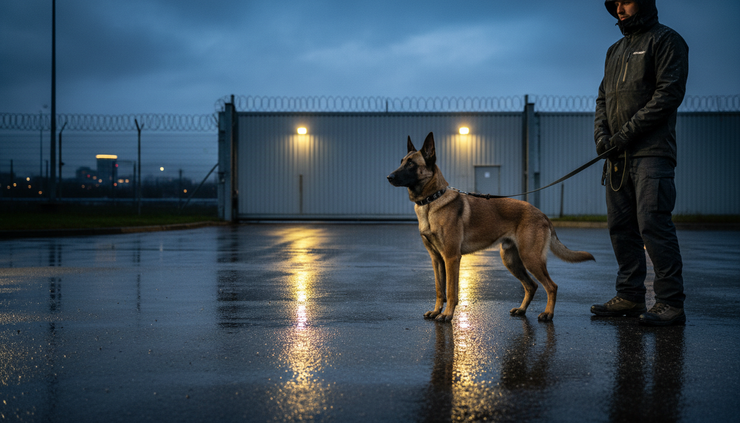
The psychology behind K9 deterrence
K9 patrols work partly because they affect emotion as well as logic.
Cameras make people think about evidence. Guards make people think about being challenged. Dogs make people think about being caught.
That difference matters. Theft and robbery often involve confidence. The offender believes they can control the situation, scare someone into compliance, or leave before anyone reacts. A dog introduces uncertainty. It is fast, alert, and difficult to distract. The person considering an offence may not know exactly what the dog will do, but they understand the risk has increased.
Several psychological effects are at play.
The fear of immediate consequences
A barking or alert dog feels immediate in a way that a camera does not. CCTV may lead to identification later. An alarm may bring help after a delay. A K9 unit is present now.
That immediacy can interrupt an offender’s momentum. Instead of thinking about the item they plan to steal or the person they plan to rob, they start thinking about escape, noise, injury, arrest, and witnesses.
The perception of stronger control
A site with K9 patrols looks organised. It signals that the owner or security team has invested in protection and expects trouble to be challenged. That perception can push offenders towards easier targets.
This is especially relevant for repeat theft, such as fuel theft, tool theft, metal theft, stock theft, and robberies near closing time. Offenders often return to places that felt easy. If a K9 team appears, the site may no longer feel worth the risk.
The uncertainty factor
Many security measures become predictable over time. Dogs do not behave like static equipment. They move, react, sniff, watch, and alert.
For a potential criminal, this uncertainty has a deterrent value of its own. They cannot be sure whether the dog has detected them. They cannot easily tell how quickly the handler can reach them. They cannot rely on silence or darkness in the same way.
What statistics and case evidence tell us
There is no single statistic that proves every K9 patrol will reduce theft and robbery by a fixed percentage. Crime prevention rarely works that way. Results depend on the site, the handler, training quality, patrol frequency, local crime patterns, lighting, access control, and how well security teams use intelligence.
Still, the evidence around visible guardianship, targeted patrol, and dog-assisted interventions is strong enough to explain why K9 teams remain common in both public policing and private security.
The key lesson from patrol research is consistent: visible patrols work best when they are focused on the places and times where crime is most likely.
The Philadelphia Foot Patrol Experiment is useful because it shows that targeted patrol can change offender behaviour. A 23% reduction in violent crime in patrol areas is a significant result, and it supports the idea that presence matters when deployed properly.
Hot spot policing reviews have also found that focused policing in small high-crime areas can reduce crime without simply pushing all crime to nearby streets. Again, these studies are not limited to dog patrols, but they support the logic behind placing K9 units in vulnerable zones rather than sending them out at random.
Case evidence from police and security operations also shows how dogs help during live incidents. Publicly reported police dog deployments often involve dogs locating suspects who fled after burglary, robbery, vehicle theft, or violent disorder. In those cases, the dog’s tracking ability, speed, and presence help officers or handlers find people who might otherwise escape or remain hidden.
For private security, common successful interventions include:
Intruders leaving a construction site after hearing a dog team approach
Suspected thieves abandoning stolen goods when challenged by a K9 handler
Trespassers being located in large yards or storage areas
Robbery attempts being discouraged by visible patrols near entrances, cash-handling points, or closing routes
These outcomes often do not appear in national crime statistics because many are prevented before they become recorded offences. That is one reason deterrence can be hard to measure. The best security success is often the incident that never happens.

Where K9 patrols are most useful
K9 patrols are not equally suited to every environment. They work best where visibility, mobility, and deterrence matter.
Strong use cases include:
Construction sites with tools, fuel, copper, plant machinery, or temporary fencing
Warehouses and distribution centres with large perimeters
Retail parks and shopping areas with repeated theft or robbery risk
Car parks affected by vehicle crime
Transport sites with out-of-hours trespass
Vacant properties and industrial units
Events where crowd movement and perimeter control need support
The best results come when the patrol has a clear purpose. Random presence may help, but targeted deployment is better. That means using incident records, staff reports, alarm logs, and local crime patterns to decide where and when dog teams should patrol.
For example, if thefts happen between 22:00 and 02:00 near a rear service road, a K9 patrol should focus on that pattern. If robberies are more likely at closing time, the patrol should be visible during staff departure and cash movement. If intruders enter through a damaged fence line, that area should receive repeated checks until the physical weakness is fixed.
A dog patrol should support the wider plan, not cover for poor security basics.
K9 patrols work best with layered security
The most effective security does not rely on one tool. It layers several defences so offenders face friction at every stage.
A strong plan may include:
Good lighting around entrances, exits, and parking areas
Clear fencing, gates, and locks
Monitored alarms and CCTV
Staff procedures for opening and closing
Incident reporting and pattern tracking
K9 patrols at high-risk times
Clear signage where lawful and appropriate
Each layer plays a role. CCTV records and verifies. Lighting removes hiding places. Alarms create early warning. Human guards assess behaviour and make decisions. Dogs add detection, mobility, and deterrence.
This combination is especially powerful against theft and robbery because those offences depend on speed and confidence. The more barriers an offender sees, the less attractive the target becomes.
What good K9 deployment looks like
A professional K9 patrol depends on control. The dog should be trained, fit for the environment, and handled by someone who understands both security and animal behaviour.
Good deployment includes:
Clear risk assessment before patrol
A handler who keeps the dog under control at all times
Proper welfare, rest, water, and transport
Training suited to the site and threat type
Accurate incident logs
Communication with other guards, police, or site managers
Proportionate response to suspicious behaviour
The dog’s role is to deter, detect, and support safety. Poorly controlled dogs create risk, harm trust, and expose organisations to legal problems. A well-run K9 operation should feel calm and controlled, not aggressive or theatrical.
In the UK, any security deployment should also follow relevant law, licensing rules, insurance requirements, and animal welfare standards. This article is for general information only and is not legal advice.

The real value is prevention
The best argument for K9 patrols is simple: they make crime feel harder.
A trained dog team can make a dark site feel watched, a vulnerable entrance feel protected, and a would-be robbery feel too risky to attempt. The effect is practical and psychological at the same time. Dogs help detect hidden threats, support handlers during incidents, and send a clear message before anyone crosses the line.
K9 patrols deter theft and robbery most effectively when they are targeted, professional, and part of a wider security plan. Used well, they do more than respond to crime. They help stop it from happening in the first place.


Comments